
Alligator vs Crocodile Leather: How to Tell the Difference
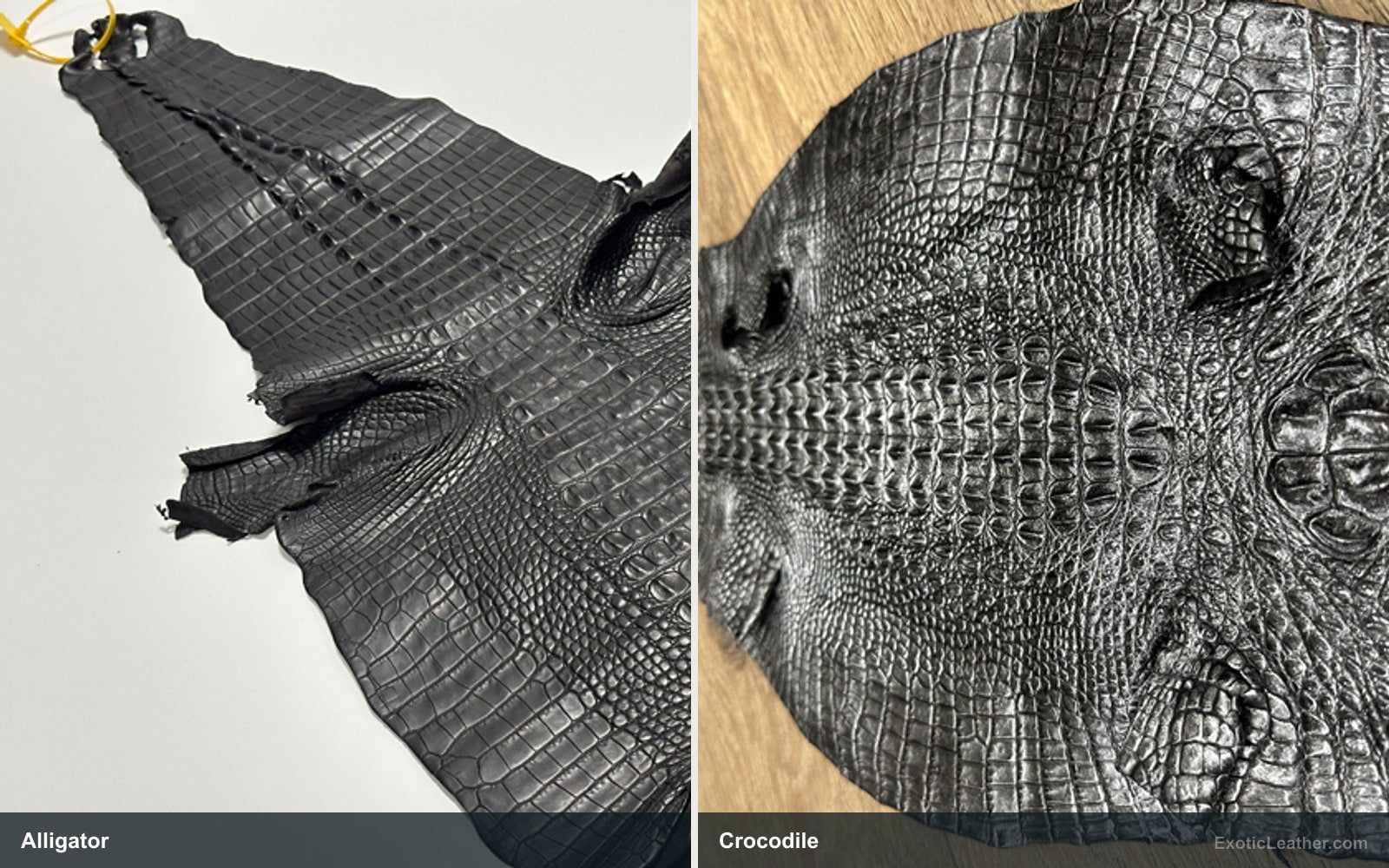
American alligator and true crocodile leather differ most clearly in species specific features such as the alligator’s umbilical scar and the sensory organ pores visible on many crocodile scales.
Both can be soft, durable, and valuable. Quality cannot be ranked from the common name alone.
What Is the Main Difference Between Alligator and Crocodile Leather?
The most useful visual differences are the alligator’s umbilical scar and the small sensory organ pores commonly visible on crocodile scales.
Scale rows and flank patterns also differ, but they change across each hide. Species records remain important when diagnostic sections are absent.
| Buying question | Alligator leather | Crocodile leather |
|---|---|---|
| Useful visual clue | Umbilical scar on a diagnostic belly section; no pore per scale pattern on American alligator belly | A small sensory pore may be visible on many scales |
| Softness | Can be very soft and pliable | Can be equally soft depending on species, tannage, and finish |
| Best choice | Choose for the actual scale layout, width, grade, and finish | Choose for the actual scale layout, width, grade, and finish |
Does Crocodile Leather Have Pores?
Many true crocodile leathers show a small sensory organ pore on individual scales.
The pore may be subtle under glaze, pigment, or heavy finishing. American alligator belly leather generally does not show the same pore per scale pattern.
Is Alligator Leather Softer Than Crocodile?
Not always. High quality alligator and crocodile belly leather can both be very soft and pliable.
Species, size, tannage, thickness, finish, and cut can matter more than the label. Compare the actual hides instead of assuming all alligator is softer.
Which Is More Durable?
Both can be durable when the leather, reinforcement, and construction fit the item.
Repeated bending across a thin hinge, unsupported edge, or thick ridge can damage either material. Durability claims should describe the intended product.
Which Is More Expensive?
American alligator and selected crocodile species can both command high prices, with grade, belly width, tannery, finish, and usable area driving the final cost.
A clean wide crocodile belly may cost more than a smaller or flawed alligator hide, and the reverse can also be true.
Which Is Better for Watch Straps, Wallets, Bags, Belts, and Boots?
Either can work, so choose by scale size, flexibility, cut, width, matching needs, and budget.
Small scales fit watch straps; clean belly panels suit wallets and bags; tails and hornbacks create bold belts and boots.
Can a Small Finished Panel Be Identified Reliably?
Not always. A small panel may omit the umbilical scar, pores, flank transition, head bumps, and full hide shape.
Paint, glaze, sanding, and embossing further reduce certainty. Use product labeling, supplier records, and multiple clues.
How Can Either Be Distinguished From Embossed Cowhide?
Look for natural scale transitions, deep varied hinge lines, full hide shape, diagnostic species features, and a description that names the base material.
Repeated groups of identical scales suggest embossing, but modern embossed cowhide can include deliberate variation.
Can Alligator and Crocodile Hides Be Matched for Paired Goods?
Hides can be selected for similar color, finish, belly width, scale size, and overall symmetry, but genuine skins will never be identical.
Paired footwear, watch straps, or bag panels should be laid out together so natural pattern changes look intentional across the finished set.
Which Gives More Usable Area for Small Goods, Alligator or Crocodile?
Usable area depends on the individual hide, belly width, grade, scale size, cut, and project pattern rather than a universal species advantage.
A smaller clean hide can yield more useful parts than a larger hide with central flaws.
About This Guide
Our guides draw on more than 16 years of direct exotic leather industry experience and a multigenerational family background working with hides. We combine that history with firsthand experience across many leather types and practical lessons learned through hands on trial and error.
Check Current Availability
Check current alligator leather availability.
Check current crocodile leather availability.